Napoleon's Regular Hexagon
The following lovely extension of Napoleon's theorem to a regular hexagon is accredited to Dao Thanh Oai from Vietnam:
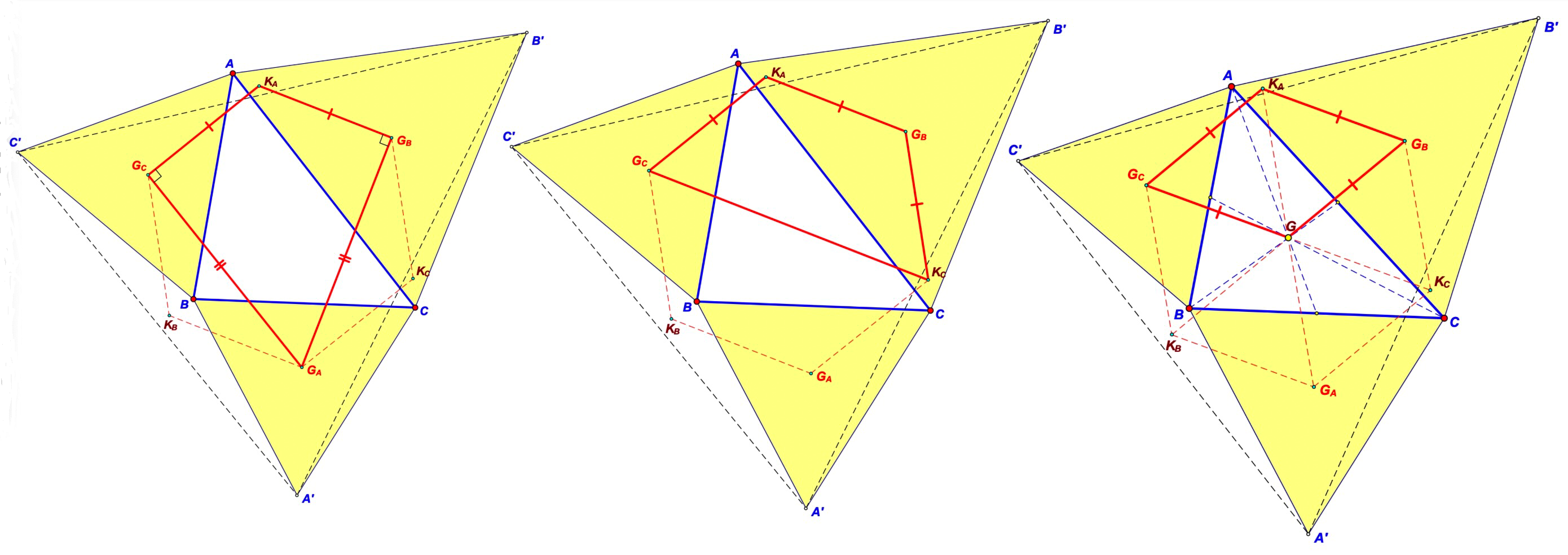
Let ABC′, BCA′, and CAB′ be equilateral triangles constructed on the sides of ΔABC. Define centroids GA, GB, GC, KA, KB, KC of triangles BCA′, CAB′, ABC′, AB′C′, A′BC′, A′B′C, respectively. Then the hexagon GAKCGBKAGCKB is regular.
Napoleon's Regular Hexagon
Challenge 1
1) Can you explain why (prove that) Napoleon's Regular Hexagon result is true?
Hint: Try using the properties of the Fermat-Torricelli point in conjuction with those of Napoleon's theorem and of centroids.
2) Compare your proof with the short elegant one given at Cut the Knot at: Napoleon's Hexagon: Solution.
Special Cases
Napoleon's regular hexagon lends itself to some interesting special cases, for example:
a) selecting centroids GA, GB, KA, GC, a right kite GAGBKBGC is obtained - see 1st figure below.
b) selecting centroids KA, GC, KC, GB, a trilateral trapezium KAGCKCGB is obtained - see 2nd figure below.
c) selecting centroids KA, GC, G, GB, where G is the centroid of the original ΔABC (coinciding with the centre of the Napoleon regular hexagon), a rhombus KAGCGGB is obtained - see 3rd figure below.
(Note: The rhombus in c) is formed differently from the rhombus in The 120° Rhombus Theorem.
Explore More
3) Since Napoleon's Theorem and the Fermat-Torriceli point can be generalized in several ways by using similar triangles, etc., this problem definitely invites further exploration: what happens if instead of equilateral triangles, similar triangles or other types of triangles are used? For example, what happens if:
a) Similar isosceles triangles are used? (Click on the 'Link to similar isosceles △'s' button & explore the new sketch).
b) Triangles (not necessarily similar) are used where the two angles adjacent to each vertex of the △ABC are equal? (In other words, Jacobi's configuration)? (Click on the 'Link to Fermat-Torricelli general △'s' button & explore the new sketch).
c) Arbitrary Triangles are used? (Click on the 'Link to arbitrary △'s' button & explore the new sketch).
Conjecture
4) What do you notice from a), b) & c) above? Can you a formulate & state a conjecture?
Challenge 2
In the above exploration you should've noticed that the formed hexagon is no longer regular, but it remains a parallelo-hexagon (a hexagon with opposite side equal & parallel). Check by dragging (with arbitrary triangles on the sides) that the parallelo-hexagon can be concave as well as crossed.
5) Can you explain why (prove that) this generalization to arbitrary triangles on the sides is true?
Hint: Try using the properties of centroids.
6) Compare your proof with the proof given in De Villiers (2007).
7) Can you generalize further to other 2n-gons? Check your answer in relation to the reference given below or at this dynamic geometry page: Formed Parallelo-hexagon: Solution & Further Generalization.
References
De Villiers, M. (2007). A hexagon result and its generalisation via proof. The Montana Mathematics Enthusiast, Vol. 4, No. 2 (June), pp. 188-192.
De Villiers, M. (2018). Tiling with a Trilateral Trapezium and Penrose Tiles. Learning and Teaching Mathematics, No. 25, pp. 6-10.
Related Links
The Center of Gravity (Centroid) of a Triangle (Rethinking Proof activity)
The Fermat-Torricelli Point (Rethinking Proof activity)
Napoleon's Theorem (Rethinking Proof activity)
Miquel's Theorem (Rethinking Proof activity)
Napoleon's Theorem: Generalizations, Variations & Converses
Dao Thanh Oai’s hexagon generalization of Napoleon’s theorem
A Fundamental Theorem of Similarity
Triangle Centroids of a Hexagon form a Parallelo-Hexagon: A generalization of Varignon's Theorem
Fermat-Torricelli Point Generalization (aka Jacobi's theorem) plus Further Generalizations
The 120° Rhombus (or Conjoined Equilateral Triangles) Theorem
Jha and Savarn’s generalisation of Napoleon’s theorem
Attached Regular Pentagons form Congruent Equilateral Triangles
Three different centroids (balancing points) of a quadrilateral
Van Aubel Vertex Centroid & its Generalization
Some Variations of Vecten configurations
Dirk Laurie Tribute Problem (Special case of Asymmetric Propeller)
Geometry Loci Doodling of the Centroids of a Cyclic Quadrilateral
Easy Hexagon Explorations
External Links
Napoleon's theorem (Wikipedia)
Fermat point (Wikipedia)
Napoleon's Theorem (Cut The Knot)
The Fermat Point and Generalizations (Cut The Knot)
Aimssec Lesson Activities (African Institute for Mathematical Sciences Schools Enrichment Centre)
UCT Mathematics Competition Training Material
SA Mathematics Olympiad Questions and worked solutions for past South African Mathematics Olympiad papers can be found at this link.
(Note, however, that prospective users will need to register and log in to be able to view past papers and solutions.)
********************************
Back to "Dynamic Geometry Sketches"
Back to "Student Explorations"
Michael de Villiers, created with WebSketchpad, 4 Jan Nov 2026; updated 7 Jan 2026; 7 March 2026; 4 April 2026.