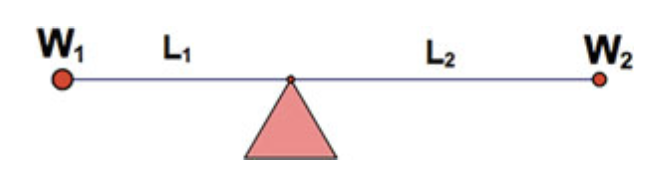
The implementation of the principles of physics has since ancient times been a productive approach in many areas of mathematics for not only discovering new results, but also logically explaining (proving) them.
.....For example, Archimedes (c.287– c.212 BC) of Syracuse used the centroids (centres of gravity) of figures, and the law of the lever, to deduce the volumes of spheres, cones, and pyramids (Heath 1897; Polya 1954, 1977; Hawking 2006; Assis & Magnaghi 2012). Similarly the Italian engineer Giovanni Ceva (1647–1734 AD) used a comprehensive approach to elementary geometry by means of static considerations.
.....What follows below is an approach, in spirit similar that of Archimedes, based on the law of the lever for locating and explaining the centroid (balancing point or centre of gravity) of polygons with weights placed at the vertices. (Note that the weight of the perimeter or interior is ignored or assumed to be neglibly small in comparison to the weights at the vertices).
The Center of Gravity of a (Vertex) Triangle & (Vertex) Quadrilateral
Acknowledgement: I'm grateful to Walter Whiteley, York University, Canada, who kindly provided me with the first four Sketchpad sketches used above.
Notes
1) The first three slides show the concurrency of the medians as well as explaining why the ratio into which the medians are divided by the centroid is 2:1.
2) The fourth slide illustrates Ceva's theorem when different weights are placed at the vertices of a triangle.
3) The last slide shows how moving the weights at the vertices of a quadrilateral to the midpoints of the sides, we obtain Varignon's parallelogram - so from the properties of a parallelogram, it follows that the balancing point (vertex centroid) is located at the intersection of its diagonals.
4) One can also use arguments from physics in the same way to explain/prove Varignon's theorem (Hanna & Jahnke, 2002).
5) The last slide also shows two other ways of finding the centroid:
.....a) By placing the weights at the midpoints of the diagonals of ABCD, the centroid would be located at the midpoint connecting the midpoints of the diagonals.
.....b) By taking the centroids of the four triangles ABC, BCD, CDA and DAB, we obtain a quadrilateral homothetic to the original, and the centroid is located at the center of the homothety (also see Point Mass (Vertex) Centroid of Quadrilateral).
6) Using balancing weights is also useful for determining the other two centroids of a quadrilateral, namely, Centroid of Cardboard Quadrilateral and Centroid of Perimeter Quadrilateral.
7) The method of balancing weights was also effectively used in the derivation and proof of this result: Quadrilateral Balancing Theorem (De Villiers, 2007/2008).
8) Another example of the application of the 'resultant parallelogram of forces' from physics is the following: Generalizations of a theorem of Sylvester.
9) Kogan (1974) also uses forces from mechanics in physics in innovative ways to prove several geometry theorems including the concurrency of the medians, altitudes and angle bisectors of a triangle.
10) On the other hand, Flores (2002) uses the kinematic method, in particular, the theory of velocities, to consider the points (vertices) of geometrical figures as endpoints of changing vectors to demonstrate and explain several geometric results, including some related to the (vertex) centroid of a quadrilateral.
References & Readings
Assis, A. K. T. & Magnaghi, C. P. (2012). The Illustrated Method of Archimedes: Utilizing the Law of the Lever to Calculate
Areas, Volumes, and Centers of Gravity. Montreal, Quebec H2W 2B2 Canada, Publisher: C. Roy Keys Inc.
De Villiers, M. (2007/2008). A Question of Balance: An Application of Centroids. The Mathematical Gazette, Nov 2007, pp. 525-528; March 2008, pp. 167-169.
Flores, A. (2002). The Kinematic Method in Geometry. Primus, 12:4, pp. 321-333, DOI: 10.1080/10511970208984038.
Hawking, S. (2006). The method of Archimedes treating of mechanical problems– to Eratosthenes. In: Hawking, S. (ed) God created the integers. Penguin Books, London, pp 209–239.
Heath, T.L. (1897). The works of Archimedes. Cambridge University Press, Cambridge.
Polya, G. (1954). Induction & analogy in mathematics, vol 1. Princeton, Princeton, pp 155–158.
Polya, G. (1977). Mathematical Methods in Science. Washington, DC: Mathematical Association of America, pp. 53-57; pp. 65-74.
Hanna, G. & Jahnke, H.N. (2002). Arguments from Physics in Mathematical Proofs: An Educational Perspective. For the Learning of Mathematics, Vol. 22, No. 3 (Nov.), pp. 38-45.
Kogan, B. Yu. (1974). The Application of Mechanics to Geometry. The University of Chicago Press, Chicago, IL 60637.
Oliver, P.N. (2001). Pierre Varignon and the Parallelogram Theorem. Mathematics Teacher, Vol. 94, No. 4, April, pp. 316-319.
Related Links
Experimentally Finding the Medians and Centroid of a Triangle
Experimentally Finding the Centroid of a Triangle with Different Weights at the Vertices
The Center of Gravity of a Triangle (Rethinking Proof activity - concurrency of medians, Ceva's theorem)
Three different centroids (balancing points) of a quadrilateral
Kite Midpoints (Rethinking Proof activity - generalizes to Varignon's theorem)
A generalization of Varignon's Theorem
Quadrilateral Balancing Theorem: Another 'Van Aubel-like' theorem
Van Aubel (Vertex) Centroid & its Generalization
Generalizations of a theorem of Sylvester
Rugby Place-kicking Problem - Modelling
External Links
A Simple Lever (Wolfram Demonstration Project)
Lever (Wikipedia)
The Method of Mechanical Theorems (Wikipedia)
Varignon's theorem (Wikipedia)
Homothety - an Affine Transform (Cut The Knot)
SA Mathematics Olympiad Questions and worked solutions for past South African Mathematics Olympiad papers can be found at this link.
(Note, however, that prospective users will need to register and log in to be able to view past papers and solutions.)
********************************
Back to "Dynamic Geometry Sketches"
Back to "Student Explorations"
Michael de Villiers, created with WebSketchpad, 20 Nov 2025.